FIND OUT...
HOW RESTORATIVE ARE YOU?
How restorative are you?
A self-assessment drawing on your individual practice, communication habits, and the culture of the communities you're part of. No right answers, only useful ones.
Your results are ready.
Enter your name and email to see your restorative score, dimension breakdown, and personalized growth edge. I'll also send you a copy to reference later.
No spam, ever. Unsubscribe anytime. Your results are calculated and shown immediately.
Your growing edge
Where to focus next
Ready to go deeper?
The Introduction to Restorative Justice Practices workshop is a full-day, CEU-eligible training that gives you the language, tools, and lived practice to move from instinct to skill — whether you're working with students, colleagues, or entire organizations.
THE FRAMEWORK
THE SOCIAL DISCIPLINE WINDOW
The Social Discipline Window is one of the foundational frameworks of Restorative Practices — a simple but extraordinarily revealing model for understanding how we use power in relationship with others.
Developed by Ted Wachtel at the International Institute for Restorative Practices, the model places any authority relationship on two axes: how much control (limit-setting, expectations, accountability) you hold, and how much support (warmth, curiosity, care for the person) you offer alongside it.
The combination of those two dimensions produces four distinct styles of holding power. We call them the four Power Styles. And most of us have one dominant style that we default to, especially under stress, especially in the relationships that matter most.
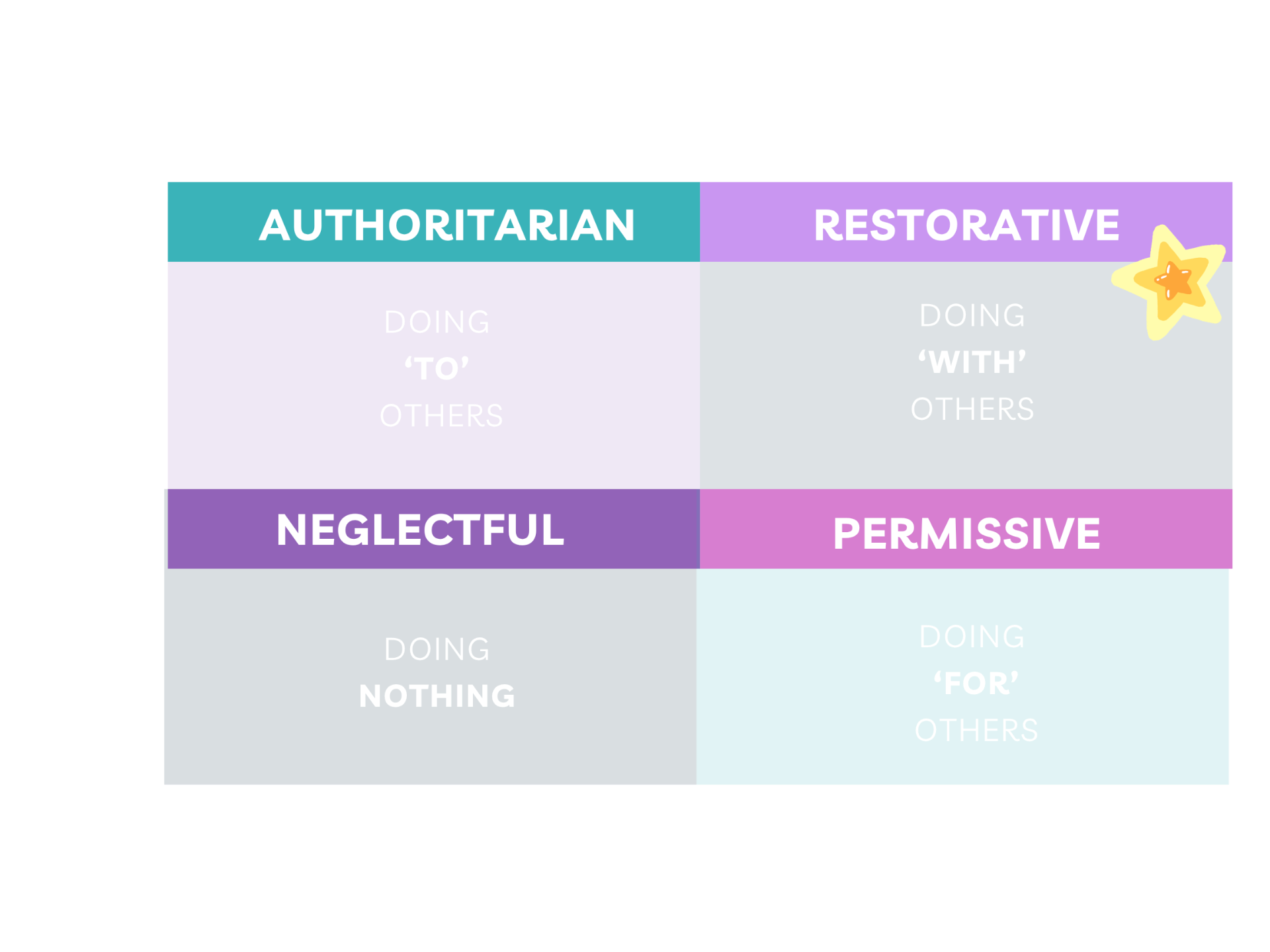
We develop our Power Style early. We inherit it from how we were parented, taught, and managed. We absorb it from the institutional cultures we move through. And without conscious reflection, we replicate it... Even when it contradicts our values, our intentions, and the kind of leader, teacher, parent, or human we are trying to be.
While we all have predispositions, no one stays in any section of the window 100% of the time and each area of the window has its value.
"Power at its best is love implementing the demands of justice, and justice at its best is power correcting everything that stands against love."
— Martin Luther King Jr.
THE FUNDAMENTAL HYPOTHESIS
THE HEART OF RESTORATIVE PRACTICES
Underlying the Social Discipline Window and all of Restorative Practices is a deceptively simple idea. IIRP calls it the Fundamental Hypothesis:
"Human beings are happier, more cooperative and productive, and more likely to make positive changes in their behavior when those in positions of authority do things with them, rather than to them or for them"
- Ted Wachtel, International Institute of Restorative Practices
With. Not to. Not for. With.
That single word contains an entire philosophy of relationship. It is the difference between a principal who disciplines a student and a principal who gives a student the room to be accountable. Between a therapist who intervenes and a therapist who walks alongside. Between a facilitator who manages a group and one who trusts it.
Restorative Practices exist to close the gap between how we currently use power and how we want to. Helping us to move from to and for toward with. The Social Discipline Window shows us where we are on that journey. The quiz you're about to take begins it.
THE MODEL
FOUR QUADRANTS
A Map of Power.
High control · High support
Restorative
High expectations held within genuine relationship.
High control · Low support
Authoritarian
Clear expectations, firm consequences... but relationship is secondary.
Low control · High support
Permissive
Warm without clear expectations. Relationships matter, but accountability gets lost.
Low control · Low support
Neglectful
Disengaged from both accountability and relationship.
Your quiz result will place you in one of these 4 quadrants and show you the path to a more restorative way of being with others.
Most of us move between all four depending on the relationship, the context, and how regulated our nervous system is in the moment. The quiz will show you where you tend to land, and more importantly, what becomes possible when you move toward with.
· · · 🌀 · · ·
YOUR TURN
READY TO SEE YOUR
Power Style?
Five minutes. Ten questions. One honest look at how you hold power and what it might look like to hold it differently.